ASWB BSW LCSW MSW | Exam Prep
- 4.7
- Rating
- 10.00K
- Installs
- Free
- Price
 Analysis by App-foxy
Preparing for a social work licensing exam is rarely a matter of simply reading more. The harder part is turning a large body of professional knowledge into quick, defensible decisions under time pressure. That is the problem I found myself testing with ASWB BSW LCSW MSW | Exam Prep, an education app from Prepia Inc. It is aimed at people working toward the ASWB BSW, LCSW, MSW, and Advanced Generalist examinations, so its value depends less on casual browsing and more on whether it fits into a disciplined study routine.
My first impression is that this is best treated as a focused practice companion rather than a complete replacement for a textbook, course, or official exam guidance. The app is free to install, carries an Everyone age rating, and has reached over ten thousand installs. Its average rating is 4.7 from around 275 ratings, which suggests that many users find the format useful, although a rating alone cannot tell me whether it matches every learner’s preferred study method.
The important question is practical: can I open it when I have a short block of time, work through exam-style preparation, and leave with a clearer idea of what I need to review next? That input-to-outcome workflow is where this app makes the most sense. It starts with uncertainty about readiness, moves through targeted practice, and ideally ends with a more honest study plan.
You May Also Like

 AccuWeather: Weather Radar
AccuWeather Review: A Quick, Clear Forecast for Everyday Decisions
For everyday plans, the best forecast is the one you can understand quickly. AccuWeather makes rain timing, radar, and local conditions easy to act on, with a few trade-offs.

 Hill Climb Racing
Why Hill Climb Racing Still Turns Crashes Into One More Run
A tiny car, a bumpy hill and one more upgrade: Hill Climb Racing keeps resurfacing because its simple chaos makes every near-miss feel personal.

 AliExpress - Shopping App
AliExpress Makes Global Shopping Feel Personal, but Shoppers Bear the Risk
AliExpress turns a global marketplace into a pocket-sized discovery engine. Its reach is useful, its shopping loop compelling, and its trade-offs easy to miss.

 Lords Mobile: Kingdom Wars
Lords Mobile Is a Kingdom-Building Routine, Not a Quick Match
A case-by-case verdict on the building, battles, device demands, and social commitments that make Lords Mobile rewarding for some players and exhausting for others.

 PDF Scanner app - TapScanner
TapScanner Makes Paperwork Easier to Capture, Check, and Share
TapScanner makes scanning with a phone feel less like a rescue operation and more like a dependable step in getting work done. Its capture tools are useful, though not flawless.

 Block Blast!
 Shows How Much a Puzzle Game Can Leave Out
A quiet grid game shows why puzzle players increasingly value instant clarity, repeatable skill and low-pressure play—and where the genre still needs to catch up.
More From Our News Desk
View All News


From a vague study plan to a usable daily routine
I find that a study routine becomes easier to keep when each session has a small, clear purpose rather than an ambitious promise to cover everything. This section looks at how I would turn short practice windows into a repeatable plan, while using mistakes to decide what deserves attention next. That practical starting point leads into the question of how to choose a useful first session.
Choosing the right starting point
I would not begin by treating every exam label in the app as interchangeable. A BSW candidate and an LCSW candidate may share broad social work principles, but their preparation needs are not identical. The first useful handoff is from the learner to the correct exam track: identify the credential being pursued, then use the relevant material instead of answering questions merely because they are available.
This sounds obvious, but it prevents a common mistake with exam-prep apps. A large question bank can create the feeling of progress even when the practice is poorly matched to the actual goal. I would keep a simple note outside the app with the exam level, the topics that feel weakest, and the date of the next serious review milestone. That note becomes the bridge between what the app shows me and what I do afterward.
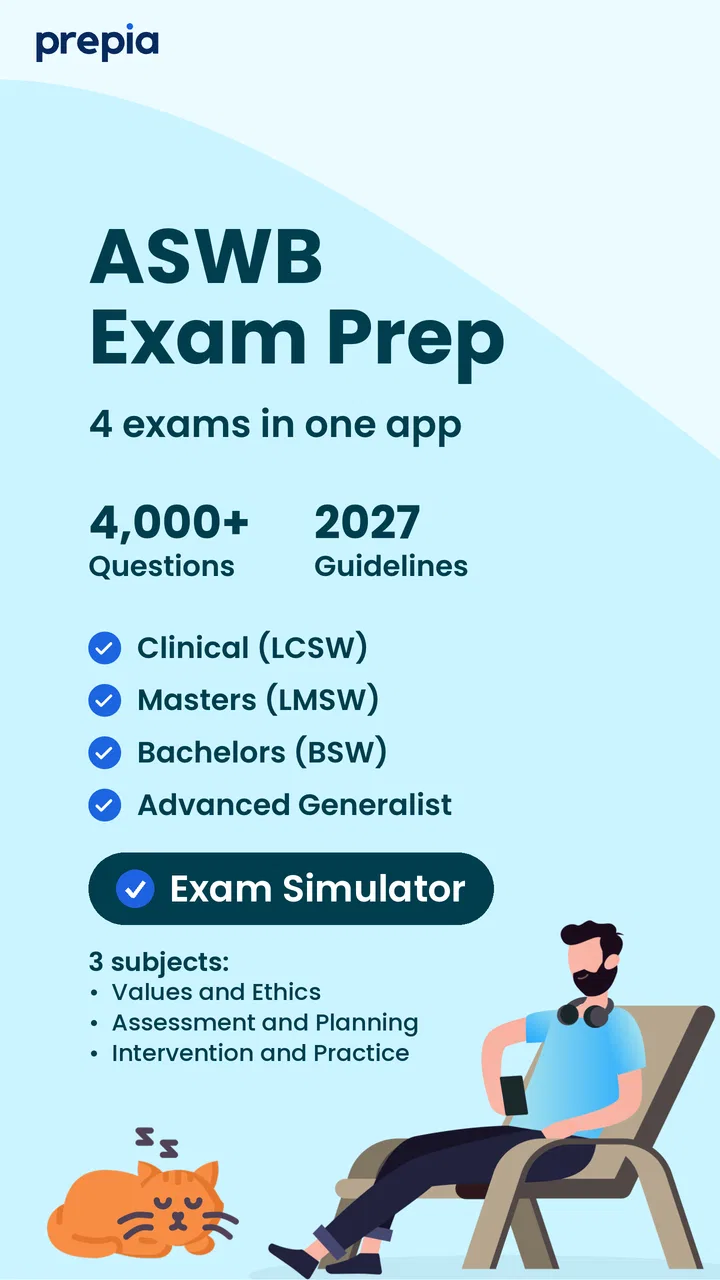
The app’s store summary specifically covers BSW, LCSW, MSW, and Advanced Generalist Tests for 2026. I see that as a useful signal for current candidates, but not as a reason to ignore the official examination guidance for their jurisdiction. Licensing requirements and registration details are separate from practice questions. The app can support preparation; it should not be the only source used to verify eligibility, scheduling, or official exam rules.
A short session works better than passive reading
In everyday use, I would open the app with one narrow purpose. For example, after work I might have twenty minutes before dinner. Instead of trying to “study social work” in the abstract, I would complete a focused practice session, mark the questions that caused hesitation, and immediately write down why the tempting alternatives seemed plausible.
That last step is more valuable than simply counting correct answers. Licensing questions often test prioritization, ethics, safety, boundaries, assessment, or the next best intervention. If I only note that an answer was wrong, I lose the reasoning lesson. If I record the difference between an immediate safety response and a later treatment decision, the session produces something I can use tomorrow.
The strongest workflow is question, reasoning, correction, and delayed retest. I would avoid repeating a question immediately until I remember the answer by sight. A better handoff is to pause, explain the choice in my own words, move to another topic, and return later. That exposes whether I understood the principle or merely recognized the screen.
Turning mistakes into a study map
I would use the app as a diagnostic tool rather than a scoreboard. After several sessions, patterns should matter more than isolated misses. If I repeatedly hesitate between two ethically defensible options, the problem may be decision order rather than missing vocabulary. If I miss questions across several areas, I may need structured reading outside the app rather than more random practice.
A practical method is to divide mistakes into three groups: knowledge gaps, wording mistakes, and prioritization mistakes. Knowledge gaps call for reviewing concepts. Wording mistakes call for slower reading and identifying what the question actually asks. Prioritization mistakes call for comparing the urgency, safety, scope, and appropriateness of each option. This classification makes the app’s practice more useful because every incorrect response leads to a different next action.
I would also resist studying only the topics that feel comfortable. A familiar section can inflate confidence while leaving the weakest area untouched. The app is more helpful when I deliberately alternate between a difficult subject and a stronger one, using the stronger topic to maintain momentum without allowing it to dominate the routine.
Where the handoffs happen
The app is one part of a chain. The first handoff is from the learner’s goal into a selected practice path. The second is from an answer screen into personal reasoning. The third is from repeated mistakes into outside review. The final handoff is from app-based practice to timed, realistic exam preparation.
That means I would keep a notebook, document, or flashcard system beside the app. Not because the app is automatically inadequate, but because remembering a correction is easier when I restate it in language that reflects my own confusion. I might write, “I chose the intervention that sounded therapeutic, but the scenario required immediate risk assessment first.” That sentence is more useful than a bare list of missed item numbers.
For a student in a study group, the handoff can be social. I could bring one difficult question to a peer or supervisor and ask how they ranked the options. The goal would not be to collect someone else’s answer, but to compare reasoning. A question that feels obvious alone may reveal an important distinction when another person explains why they rejected the same option I chose.
A realistic week with the app
Imagine a working MSW graduate who studies during a commute break, a lunch period, and two evening sessions. On the first day, the learner uses the app to establish a baseline and notices hesitation around ethics and clinical decision-making. On the second day, instead of starting another broad session, they review notes from those mistakes and practice again with attention to the order of action.
Later in the week, the learner mixes familiar and difficult material, then completes a longer uninterrupted session when time allows. At the end of the week, they do not ask only, “What was my score?” They ask, “Which errors keep returning, and can I explain the correct reasoning without seeing the choices?” That is the outcome I would want from the app: a sharper study plan and fewer surprises about weak areas.
This routine also shows why the app may suit busy candidates. A phone-based tool can fit between larger study blocks, while a printed book is often better for deep reading and annotation. The two approaches are not competitors in every situation. I would use this app for retrieval and decision practice, then use a comprehensive resource when I need a longer explanation or a systematic review of a domain.
What the free entry point means in practice
The app is free to download, which makes it easy to test without committing money at the beginning. However, it includes in-app purchases ranging from $5.99 to $64.99 per item. I would therefore spend time evaluating the free experience before buying anything. The right question is not whether paid content exists, but whether it addresses a specific gap in my preparation and supports the way I actually study.
For someone who only needs occasional practice, paying for expanded material may not be worthwhile. For a candidate who has already built a routine and finds the available content aligned with the target exam, an optional purchase could make more sense. I would make that decision after several sessions, not during the first enthusiastic download.
This pricing structure also creates a trade-off compared with a single physical study guide or a course with a clearly defined scope. An app can be more convenient and easier to revisit, while a book may offer a more predictable one-time study path. I would compare the total cost of the resources I already use rather than assuming that a low-friction mobile start will remain the cheapest approach.
How it compares with familiar alternatives
Compared with reading a textbook, the app’s likely advantage is immediacy. I can move from uncertainty to a question and then to a correction without setting up a full desk session. That makes it useful for maintenance study, especially when I have only a short period available. The weakness is that practice alone may not provide enough context when I do not understand a concept in the first place.
Compared with flashcards, exam preparation in this format should be more useful for choosing among plausible actions rather than recalling isolated definitions. Flashcards remain better for terminology, models, and concise facts. I would not replace them entirely if memorization is one of my weak points.
Compared with a live instructor or study group, the app is private and flexible but lacks the immediate human challenge of defending an answer. That matters when my problem is not recognition but judgment. A teacher can notice a reasoning habit that I cannot see, while the app can give me repeated individual practice without coordinating schedules.
Compared with official exam materials, the app is more convenient for daily repetition, but official sources should remain the authority for exam logistics and current requirements. I would use both, with clearly separated roles: official information for what the examination is and how it is administered, and the app for building practice into ordinary days.
Where the workflow can break
The first break occurs when a learner mistakes activity for readiness. Completing many questions can feel productive even if the same reasoning error appears repeatedly. I would watch for familiar answers, rushed reading, and a tendency to stop after a correct guess. Those are signs that the input is not producing a reliable outcome.
The second break is overconfidence from the rating or from a few good sessions. The app has a strong 4.7 average, but other users’ satisfaction cannot predict my performance. I would judge it by whether I can explain decisions, transfer principles to unfamiliar wording, and maintain accuracy when tired or timed.
The third break is using the wrong level of preparation. A BSW learner may not need the same depth or emphasis as an advanced clinical candidate, and an LCSW candidate should not assume that broad exposure automatically covers the demands of clinical decision-making. Selecting material carefully is more important than filling every available minute.
There is also a practical financial friction. Because optional purchases can reach $64.99 per item, I would check what each purchase adds before confirming it and avoid buying multiple resources impulsively. A paid item should solve a defined problem in the study workflow, such as insufficient practice or a missing area, rather than simply making the app feel more complete.
Finally, mobile study can encourage fragmented attention. Notifications, small screens, and multitasking can weaken the very judgment the learner is trying to train. For serious sessions, I would silence distractions, read every scenario slowly, and reserve quick phone practice for review rather than treating it as the only form of preparation.
Who should use it, and who should look elsewhere
I think this app is a good match for candidates who need a portable way to practice ASWB-related decisions, identify weak areas, and keep study moving during an unpredictable schedule. It is especially suitable for someone who already has core study material and wants a repeatable question-based routine instead of another long reading assignment.
I would be more cautious recommending it as the sole resource to a learner starting from zero, someone who needs detailed teaching before attempting questions, or anyone who wants a fully guided course with a fixed sequence and personal feedback. Those users may benefit more from a structured class, a comprehensive manual, or a tutor, with this app added later for reinforcement.
The Everyone rating makes the app broadly accessible from an age-classification perspective, but the subject itself is professional exam preparation. A casual learner looking for general social work information may find the focus too narrow, while a candidate with a clear licensing target is more likely to understand its purpose.
The outcome I would expect after consistent use
I would not measure success by how often I open the app. I would measure it by whether my decisions become faster without becoming careless, whether I can identify the central issue in a scenario, and whether my review notes become more specific. The app is valuable when it changes what I study next.
Its current version is 2.1.020, and it supports devices running Android 7.0 or later. That makes the technical entry point relatively approachable for many Android users, though the more important compatibility question is personal: will the interface and practice rhythm fit the device and routine I already use? I would install it on the phone I genuinely study with, not on a device that stays unused.
My overall view is positive but measured. This is a practical exam-prep tool, not a complete licensing education system. I like the way it can turn spare minutes into deliberate practice, especially when I use mistakes as instructions for the next study step. I would recommend starting with the free access, choosing the correct exam goal, keeping an external error log, and adding paid material only when it clearly improves the workflow.
For a candidate who needs structure, explanation, and accountability from one place, another option may be better. For someone who already understands the basics and needs frequent, portable practice for BSW, LCSW, MSW, or Advanced Generalist preparation, this app can become a useful link between studying and performing. That is the role I would give it: a focused daily companion that helps convert uncertain answers into a more deliberate path toward exam readiness.
FAQs for ASWB BSW LCSW MSW | Exam Prep
01What is ASWB BSW LCSW MSW | Exam Prep?
ASWB BSW LCSW MSW | Exam Prep is a study app designed for social work students and professionals preparing for Association of Social Work Boards licensing examinations. It typically brings practice questions, review materials, explanations, and progress tools together in one place. The content is intended to support preparation for exams such as the Bachelor’s, Master’s, and Clinical levels, although users should confirm that the available material matches their specific exam and jurisdiction.
02Which ASWB examinations does the app support?
The app is aimed at candidates preparing for several ASWB categories, including the BSW, MSW, and LCSW-related examinations. The exact organization of the practice sets and subjects may vary by version, so it is worth checking the in-app descriptions before relying on it as your primary study resource. Remember that licensing requirements, exam names, and eligibility rules can differ by state or province.
03Does this app replace official ASWB study materials or a formal review course?
No. The app is best used as a supplementary revision tool rather than a complete replacement for official ASWB information, textbooks, supervised preparation, or a structured review course. Practice questions can help you identify weak areas and become familiar with common scenarios, but they cannot guarantee exam success. Always compare the app’s content with the current ASWB exam guide and your licensing board’s requirements.
04What features can I expect while studying with the app?
During review, users can generally expect question-based practice covering important social work topics, along with answer feedback or explanations intended to reinforce learning. Depending on the app version, there may also be progress tracking, categorized quizzes, timed practice, or the ability to revisit difficult questions. These tools are useful for short daily sessions, but the quality and depth of explanations should be evaluated alongside trusted professional resources.
05Is ASWB BSW LCSW MSW | Exam Prep suitable for beginners and repeat test takers?
The app can be useful for both first-time candidates and people retaking an ASWB examination, but each group may use it differently. Beginners can use the quizzes to become familiar with exam-style reasoning and discover knowledge gaps, while repeat test takers may focus on frequently missed subjects and timed practice. It should still be combined with a personalized study plan, current clinical or academic references, and careful review of incorrect answers.
Pros
- Covers multiple social work exam levels in one app.
- Practice questions help identify weak topics before test day.
- Short study sessions work well for busy social work students.
- Useful review tool for key concepts
- ethics
- and practice areas.
- Progress tracking can help maintain a consistent preparation routine.
Cons
- Some explanations may not match the depth of official study guides.
- Question difficulty can vary from the actual ASWB examination.
- Full access may require a subscription or in-app purchase.
- Limited content may be less useful for specialized exam topics.
- Users still need official ASWB materials for current exam policies.

ASWB BSW LCSW MSW | Exam Prep
Gallery